College and university records are great resources for family history research. These include yearbooks, catalogs, school newspapers, funeral programs, photographs, and documents donated by families.
Several men in my family attended Biddle University, which became Johnson C. Smith University, an HBCU in Charlotte, N.C. Biddle’s catalogs are digitized and are online at DigitalNC, and I love exploring them because they list the names of students, their hometowns, and their majors. I often get side-tracked and find myself tumbling down rabbit holes researching people who are not related to me but are possibly related to people I know. For example, the 1903-1904 catalog, includes several students from Darien, Georgia – Frank Atkins Brown, Hector Charles Miller, David Andrew Rogers, Hercules Wilson Jr., and Harry Wilson Leake. An older catalog, the 1897-1898 edition, includes Benjamin Monroe Grant of Darien.
In the back pages of the catalogs are lists of alumni, including their cities of residence after graduation and their occupations. Most graduates became ministers or teachers, but some became doctors, mail carriers, merchants, printers, farmers, brick masons, missionaries, and Pullman porters.
South Carolina native Walter I. Lewis, who graduated from Biddle University in the class of 1877, was listed as a news reporter in Jacksonville, Fla. This caught my attention.
A Google search revealed that an essay by Lewis was included in a 1902 book titled Twentieth Century Negro Literature: Or A Cyclopedia of Thought on the Vital Topics Relating to the American Negro by 100 of America’s Greatest Negroes, edited by Daniel Wallace Culp. The book includes essays by many familiar people, including a Jacksonville native and school principal named James Weldon Johnson.
In Lewis’ essay, The Negro as a Writer, he wrote, “The writings of the Negro are full of soul. … The well nigh inexhaustible field of folk-lore of his own people is ready to be told to the world, whether in the crude dialect of the race, or in Americanized English, it matters little. It will make no difference. The English speaking people of both continents will read it if it is written by a master.”
According to Lewis’ bio in the book, he taught at a public school in Spartanburg, S.C., and at a parochial school in Tennessee, before switching to journalism. He was a field correspondent for The Florida Sentinel in Gainesville, the city editor for The Labor Union Recorder in Savannah, Georgia, and then he moved to Jacksonville, Florida, to work for The Jacksonville Advocate, The Daily American, and finally, as a reporter for The Metropolis, an evening newspaper that would become The Jacksonville Journal.
Wednesday, February 5, 2025
Prof. Walter I. Lewis, Journalist
Sunday, July 28, 2024
"The Black Pearl"
Learn more:
- Atlantic Beach. (2022). The Green Book of South Carolina. https://greenbookofsc.com/locations/atlantic-beach/
- Bush, G. W. (2016). White sand black beach: Civil rights, public space, and Miami's Virginia Key. University Press of Florida.
- Cruz, B., Berson, M., & Falls, D. (2012). Swimming not allowed: Teaching about segregated public beaches and pools. Social Studies, 103(6), 252-259.
- Gibson, J. (2015). Atlantic Beach: Historic African-American Enclave in South Carolina. National Trust for Historica Preservation. https://savingplaces.org/stories/atlantic-beach-historic-african-american-enclave-in-south-carolina#.YkULLOhKjIU
- Oglesby, C. (2022). How black beaches were developed to combat Jim Crow segregation. Eath Curiosity. https://earthincolor.co/earth-curiosity/how-black-beaches-were-developed-to-combat-jim-crow-segregation/#:~:text=In%20the%20South%2C%20Black%20beaches,entry%20for%20people%20of%20color.
- John Skeeter's Documentary on Atlantic Beach, S.C. (2013). Prince Domoniquie on YouTube. https://youtu.be/oLb8LVV6w2o
- Karhl, A. W. (2018). Free the beaches: The story of Ned Coll and the battle for America's most exclusive shoreline. Yale University Press.
- Kahrl, A. W. (2016). The land was ours: How black beaches became white wealth in the coastal South. University of North Carolina Press.
- King, H. T. (2021). Saving American Beach: The biography of African American environmentalist MaVynee Betsh. G.P. Putnam's Sons Books for Young Readers.
- Phelts, M. D. (2010). An American Beach for African Americans. University Press of Florida.
- Stephens, R. J. (2014). Atlantic Beach, South Carolina (1966- ). Black Past. https://www.blackpast.org/african-american-history/atlantic-beach-south-carolina-1966/
- Stephenson, F. (2006). Chowan Beach: Remembering an African American resort. The History Press.
- Town of Atlantic Beach, S.C. (n.d.). http://www.townofatlanticbeachsc.com/
Friday, March 31, 2023
Rev. Dr. Katie Geneva Cannon
![]() |
| Courtesy of the Katie Geneva Cannon Papers, Presbyterian Historical Society, Philadelphia PA |
On this last day of Women’s History Month, I honor my cousin and kindred spirit, the Rev. Dr. Katie Geneva Cannon, shown in a collage featuring a photo of her from the 1970s and one of her works of art from 2000.
Cousin Katie was the first African American woman to be ordained in the United Presbyterian Church (U.S.A.), the first African American woman to earn a Ph.D. at Union Theological Seminary, a renowned scholar, and a founder of the Center for Womanist Leadership. Her legacy includes many more honors and thought-provoking lectures, books, and articles.
I never met Cousin Katie in person, but we corresponded, exchanging
articles and sharing our deep admiration for our ancestor, Mary Nance Lytle, a
strong-willed courageous woman who reclaimed her children who had been sold
away during slavery.
Cousin Katie was born in Kannapolis, N.C., in 1950, and passed away in 2018. I regret I never got the chance to spend time with her and
tell her how much I admired her.
The collage above is copyrighted and is used here with permission from the Presbyterian Historical Society in Philadelphia, Pennsylvania.
Wednesday, March 8, 2023
Southern Tones and Southernaires
Second from left is Cousin James "Tunesy" Fletcher (1935-2012). He was a member of the Southern Tones of Philadelphia. Back in his hometown of Lancaster, S.C., he performed with the local group, Gospel Southernaires, along with his brothers, John Fletcher and Roosevelt Fletcher, who was the lead singer.
Sunday, January 8, 2023
George Lewis Russell, Sr.
George Lewis Russell Sr., first cousin, two times removed, was the first black Assistant Chief Clerk for the U.S. House of Representatives and served in that role for more than 17 years.
He was
the son of Joseph Samuel Russell (1886-1969) and Hattie McCauley (1887-1972). He
was born in 1924 in Concord, Cabarrus County, N.C., and graduated from Logan
High School in Concord and North Carolina A&T State University in Greensboro. He
served in the U.S. Navy during World War II.
Cousin George died of a heart attack in 1991. Several members of Congress paid tribute to him, including Rep. Kweisi Mfume, (D-Md.), and Rep.
Andrew Jacobs, Jr., (D-Ind.). This image from the Congressional Record is a tribute by Rep. Mervyn M.
Dymally, (D-Calif.), on Oct. 10, 1991, in the U.S. House of Representatives. It
reads:
“Mr. Speaker, I rise to pay tribute to a man that many
considered to be a Capitol Hill institution. For 17 years George Lewis Russell,
Sr., graced these hallowed halls, with a dignity and sense of dedication that
made him a friend to all that were fortunate enough to be touched by him.
“In his position as the Assistant Chief Clerk to Reporters, the
man we affectionately referred to as George literally had a front-row seat as
we conducted the Nation’s business. Yes, Mr. Speaker, when my friends on the
other side of the aisle were in the well giving speeches, that moment was
shared by George who sat directly behind whoever was speaking.
“Mr. Speaker, aside from his duties here in the House of
Representatives, George was a dedicated family man, active in his community,
his church, and the affairs of his college, North Carolina A&T State
University.
“Mr. Speaker, George Russell always went the extra mile to help
individuals seeking employment and was always encouraging to members and staff.
“Unfortunately, there will not be any statues or buildings here
on the Hill named after George Russell. However, we can all rest assured that
this noble man will never be forgotten on Capitol Hill or in his community.”
Sources:
Tribute
by Rep. Kweisi Mfume, (D-Md.), Congressional
Record, Oct. 8, 1991, p25753.
Tribute by Rep. Andrew Jacobs,
Jr., (D-Ind.), Congressional Record, Oct. 9, 1991, p26001.
Tribute
by Rep. Mervyn M. Dymally, (D-Calif.), Congressional
Record, Extensions of Remarks, Oct. 10, 1991, p26199.
Obituaries, The Baltimore Sun, Oct. 8, 1991, p38.
Thursday, December 22, 2022
Lytle School Legacies
![]() |
| The new Lytle's Grove Rosenwald School, 1927 |
![]() |
| Torrence-Lytle High School |
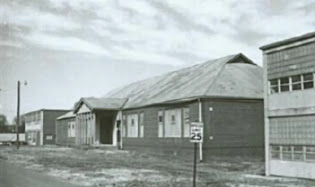
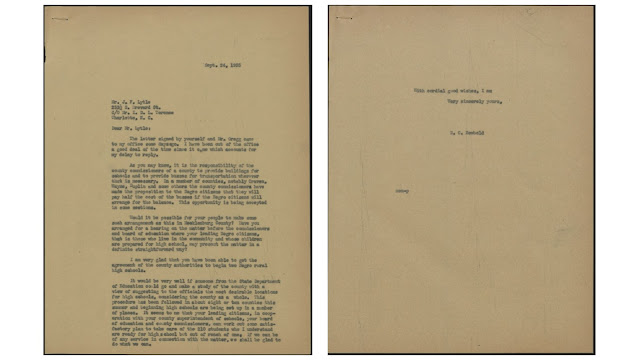
In the letter below, dated September 24, 1935, Nathan Carter Newbold, director of North Carolina's Division of Negro Education, is replying to a letter from John Frank Lytle. The letter is addressed to J.L. Lytle, in care of I.D.L. Torrence. The topic is the need for high schools and transportation in northern Mecklenburg County, to accommodate more than 200 black children who are prepared to advance but have nowhere nearby to go to school.
![]() |
| Old Lytle's Grove School, 1927 |
Charlotte-Mecklenburg Historic Landmarks Commission. (n.d.). Survey and research report for the Torrence-Lytle School. http://landmarkscommission.org/wp-content/uploads/2016/10/Torrence-Lytle-SR.pdf
Chris Folk Papers. (n.d.). A history note: Torrence-Lytle School. University of North Carolina at Charlotte. https://atkinsapps.charlotte.edu/node/17069
Corine Cannon Oral History, 2019. Pearl Digital Collections. Presbyterian Historical Society. https://digital.history.pcusa.org/islandora/object/islandora%3A150680
Griffith, Nancy. (2021). Rosenwald Schools: Special Davidson history column for Black History Month. News of Davidson. https://newsofdavidson.org/2021/02/18/34004/rosenwald-schools-special-davidson-history-column-for-black-history-month/
New Lytle's Grove School. State Archives of North Carolina. Department of Public Instruction: School Planning Section, School Photographs File, Box 5. https://www.flickr.com/photos/north-carolina-state-archives/51479650760/in/photostream/
North Carolina Digital Collections. (n.d.). Correspondence: Rosenwald Fund, Box 4, Folder E, 1927-1928. https://digital.ncdcr.gov/digital/collection/p16062coll13/id/1304/rec/2
North Carolina Digital Collections. (n.d.). General correspondence of the director, last name J to L, September 1935-August 1936. https://digital.ncdcr.gov/digital/collection/p16062coll13/id/77464/rec/1
North Carolina Digital Collections. (n.d.). Report of N.C. Newbold, State Supervisor rural schools for Negroes for North Carolina, For the Month of February 1914. https://digital.ncdcr.gov/digital/collection/p16062coll13/id/15941/rec/3
Old Lytle's Grove School. State Archives of North Carolina. Department of Public Instruction: School Planning Section, School Photographs File, Box 5. https://www.flickr.com/photos/north-carolina-state-archives/51479446819/in/photostream/
Wednesday, November 30, 2022
The Sweet Potato
I've always considered myself a child of summer, but fall has a special place in my heart. Where I live, the days are still relatively warm well into November and even December, but the nights are just chilly enough for a fire in the yard.
My husband makes the best fires, the kind of fires that make you slowly inch your chair back at first, only to scoot back up as the fire settles down to a steady simmer. A good fire brings out good stories, the true stories as well as the lies, the ones that have been somewhat embellished over time. The flames loosen the tongue and release tucked-away memories of people long gone, and the passed-down tales that they told around yard fires long extinguished.
One night on Sapelo Island, while sitting around a fire listening to lies, Cousin Tracy reached into the ashes beneath the smoldering wood and dug out a small sweet potato he had been baking. He carefully brushed it off, broke it in half, and handed a piece to me. While I normally smother my sweet potatoes in butter, cinnamon, and sugar or honey, I took a bite from the bare hot orange clump and died right there on the spot and went to heaven.
To this day, I still think about that sweet potato and how it made me feel. In each bite, I could taste the generations and savor the history and tradition, and feel the love of ancestors whose names I will never know.
Monday, April 18, 2022
Family in black and white
By Elizabeth June Torrence
It shouldn’t be a big deal -- he wasn’t lost, in fact, I knew exactly where he was supposed to be.
Four years ago I probably wouldn’t have cared that on April 1, 2022, the 1950 census would be released. I wouldn’t have known that the indexing process will take months and probably won’t be truly searchable until next year. I wouldn't have appreciated seeing the facts published for posterity.
Four years ago I got my DNA tested by Ancestry and for curiosity's sake, I uploaded the data to GEDmatch. I didn’t know if anything life-changing would come from my results, but I was intrigued by the possibilities.
In the summer of 2018, I was contacted through email by Michele. She had found me through one of the search functions on GEDmatch, “People who Match One or Both Kits.” I matched both her and her friend. She told me she had roots in Charlotte, N.C., and her great-great-grandfather had founded a school that became known as the Torrence-Lytle School.
I had a tree on Ancestry that I shared with Michele. Most, if not all the information about the Torrences I had copied from a tree my brother Richie had built before his death in 2004. She recognized my ancestor Alexander Torrence as the same man who was in Judy Hughes’ tree, whom she had met through Facebook, and she asked if I minded including Judy in our conversation. We grew as a group from there and I now had a purpose for researching my Torrence family of my own.
I knew my father was born in Charlotte, but in my head, he was from Virginia. Looking back now I realize that I didn’t really have a clue where he was from. I have his high school yearbooks from Tennessee and one from his year of college in Kentucky. He met my mother in her hometown of Fort Payne, Alabama, and I grew up in Atlanta, Georgia, where I have some vague memories of him talking about streets and places he knew as a kid.
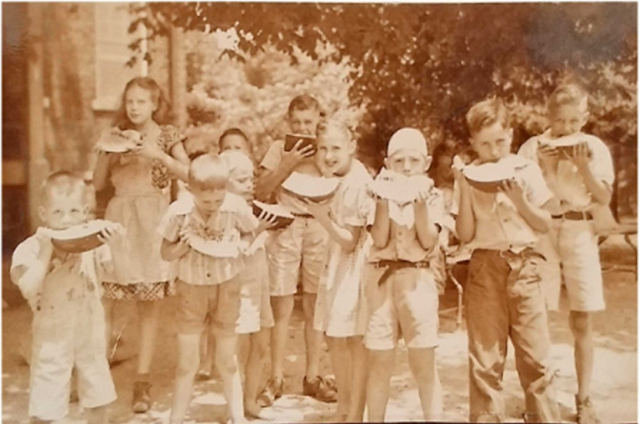
My father died when I was 11 years old and for most of my childhood struggled with alcoholism. Since I was just a kid I was never told much, but I caught pieces of things here and there. One of the very few pictures I have of my dad as a child I was told was taken at the children’s home, and on the back are the names of the other children in what I know now is my Aunt June’s handwriting.
That’s my dad on the far right, and my Aunt June is the tall girl on the left.
See, in 1950, my dad and his older sister were living in the Southern Christian Children’s Home at 1101 Cleburne Avenue in Atlanta. The Jimmy Carter Center is now located on that property. That’s how, even without an index, I could find my father in the census.
When I opened this image I burst into tears.
There he is, Richard H. Torrence, Orphan, age 12. Except he’s not an orphan.
It’s one thing to hear the stories -- it’s another to see them in black and white. The boy listed just before my father is also in the picture above. Some of the other children in this photo are listed in the census as well and I wonder what their stories are. Were they truly orphans, or were they placed there under similar circumstances to my dad and aunt? The census doesn’t tell the full story.
That story, like so many of ours, is a work in
progress.
Through our little group of cousins, I’ve totally expanded my research skills. I was really a novice when we first started exchanging emails in 2018. When I’m not working on puzzling out our various relationships from the era of slavery in North Carolina, I’m trying to piece together a timeline of my father’s life before he met my mother. Finding the little clues and sharing them with my mother has generated so many memories she has of things my father told her during their 24 years of marriage that she had never and would probably have never shared with me. She is really my only primary resource and so many of her random memories have been borne out through records I’ve found online.
It’s the combination of stories passed on and the records we find that make the whole picture possible and I’m truly grateful for that courageous email from Michele that started me on this quest. I told her then that I was ready for whatever we found -- good, bad, or ugly -- and I’ve found some of each, but I’m better off for all of it.
Elizabeth June Torrence, 2022
Wednesday, April 13, 2022
I See the Moon
Enslaved & Enslaver Descendants
On April, 9, 2022, four members of the Torrence Cousins research group participated in the virtual program, Enslaved & Enslaver: Finding Descendant Connections, presented by the North Suburban Genealogical Society and Glenview Public Library in Glenview, Ill.
Friday, February 25, 2022
Ancestral Excursions
| Old Dominion Steamship Company. Source: Library of Congress. |
| James Hampton Russell and his daughter, Kate |
| World War I draft card for James Hampton Russell (1891-1966). Registration State: Virginia; Registration County: Warwick. Source: National Archives and Records Administration/Ancestry.com |
- Bay, M. (2021). Jim Crow journeys: An excerpt from Traveling Black. Southern Spaces. https://southernspaces.org/2021/jim-crow-journeys-excerpt-traveling-black/
- Howard, P. (2014). Steamships & Ocracoke. Village Craftsmen. https://www.villagecraftsmen.com/tag/old-dominion-steamship-company/
- The new Steamship Monroe of the Old Dominion Line. (1903, Apr 18). The Cambridge Chronicle. https://cambridge.dlconsulting.com/cgi-bin/cambridge?a=d&d=Chronicle19030418-01.2.124&e=-------en-20--1--txt-txIN-------
- A new steamship; description of the Seneca of the Old Dominion Line. (1884, Dec. 3). The New York Times. https://www.nytimes.com/1884/12/03/archives/a-new-steamship-description-of-the-seneca-of-the-old-dominion-line.html
- Old Dominion Line: Along the historic James River. (1902). Old Dominion Steamboat Company.
- Old Dominions Steamship Company. (n.d.). Library of Congress. https://www.loc.gov/item/2004666887/
- Palmer, A. (2016). This segregated railway car offers a visceral reminder of the Jim Crow era. Smithsonian Magazine. https://www.smithsonianmag.com/smithsonian-institution/segregated-railway-car-offers-visceral-reminder-jim-crow-era-180959383/
- Segregation of railroad cars. (n.d.). The History Engine. University of Richmond. https://historyengine.richmond.edu/episodes/view/3273
- Strikebreakers at Norfolk. (1916, May 29). The Greensboro Daily News.
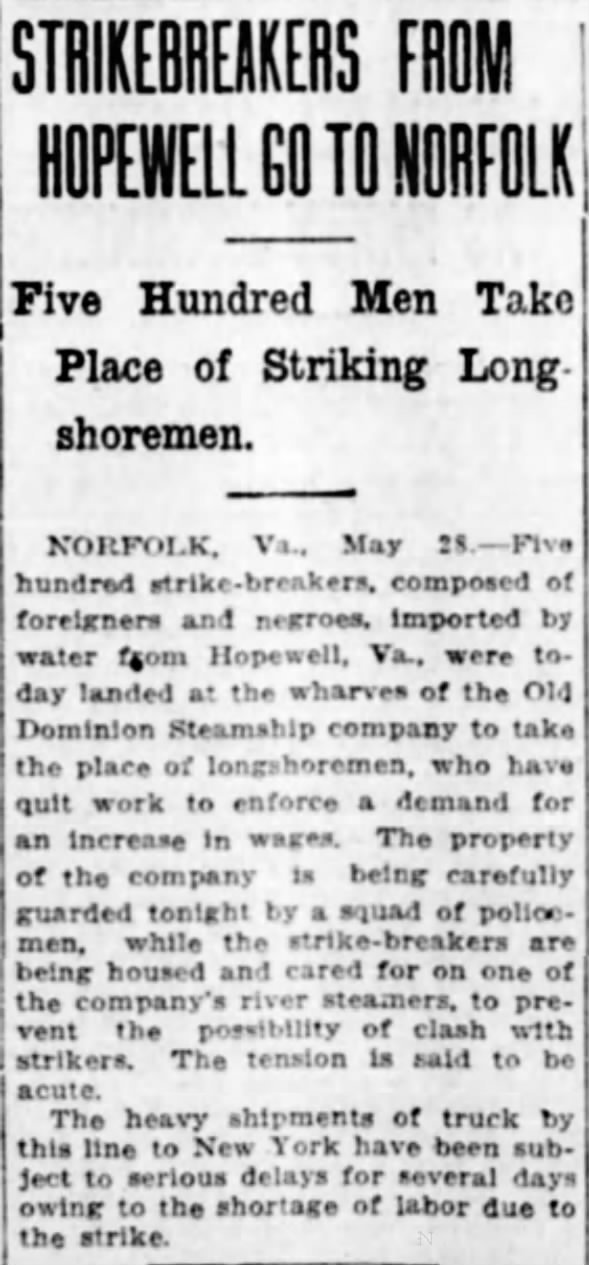
- Strikebreakers from Hopewell go to Norfolk: Five hundred men take place of striking longshoremen. (1916, May 29). The Asheville Citizen-Times.
Saturday, February 5, 2022
Featured Funeral Program
| Bernice Elizabeth Kiser Allison (1915-1987) |
Thursday, February 3, 2022
Phillis Coleman
| Phillis (Phyllis) Coleman (1823-1908) |
This is my paternal fourth-great-grandmother, Phillis (Phyllis) Coleman. She was born into slavery in Virginia in 1823, and she died in freedom in 1908, in Lancaster County, South Carolina. Her enslaver, and the father of some of her children, was Robert Brown Cunningham (1815-1885).
Friday, December 31, 2021
H. Lee Waters Film Collection
The H. Lee Waters Film Collection includes silent films documenting communities in the Carolinas and in Virginia from 1936-1942. African-American communities in Kannapolis, N.C., are included in the collection, which is in the archives of Duke University Libraries.
Look for Reel 3 of the Kannapolis footage, and scroll down to the time stamps below the video. At 18:06 on Reel 3, are students at George Washington Carver in Kannapolis. I get choked up watching this footage because my parents grew up in Kannapolis, and although they were born a few years after these videos were made, I know some of these people working and playing and going about their lives are my family.
Thursday, October 15, 2020
Mother Hillery
![]() |
| Cherokee Roses in spring, on the road to Mother Hillery’s house. |
When I’m home by myself overnight, I lock up like Mother Catherine Hillery. She was the thoughtful elderly church mother and dear cousin on Sapelo Island who wouldn’t answer the door after sunset — no exceptions.
She’d call our house in the late afternoon and say “Come get a piece of this bread pudding before the sun go down.”
The kids would scurry down the dirt road to beat that sun because the bread pudding was always warm and delicious, and she usually would slip them some pocket change.
Sweet memories.
Monday, August 17, 2020
Elizabeth Elaine Lemon: Trailblazing Woman
Note: This was a speech I delivered on Feb. 29, 2020, as part of Trailblazing African American Women of Coastal Georgia, a program presented by The Ashantilly Center at St. Cyprian's Episcopal Church and Parish Hall. -- MNJ
In my former life, as a newspaper journalist, I wrote a Family
column that was published weekly with my picture. So, when Black History Month
rolled around, I was bombarded with calls to speak at churches, civic groups, and schools.
The schools were my favorite because I actually loved the challenge of trying to hold the attention of squirming elementary
schoolchildren or engaging with middle or high school students who probably
would rather be somewhere else.
![]() |
| Elizabeth Elaine Lemon |
During Black History Month we often celebrate people who
are larger than life household names – Martin Luther King Jr. and Harriet
Tubman … Malcolm X and George Washington Carver … and Frederick Douglass.
But many of the heroes in our families and in our
communities are of the unsung variety, the ones who worked behind the scenes,
and laid the foundation for others to build upon.
Elizabeth Elaine Lemon is one of those heroes.
She was born August 4, 1904, on Sapelo Island, Georgia, the
daughter of Thomas Lemon and Lula Walker Lemon.
Her family – her parents and brothers and sisters -- called
her “Bell.”
Bell’s early childhood, the early 1900s, was a time of
changes on Sapelo Island. The land that was once dominated by the Spalding
family, the island’s last major plantation owners, was purchased by Howard
Coffin, a Detroit auto man. Coffin moved to the island and rebuilt the former
Spalding “Big House,” transforming its tabby skeleton into a beautiful
Mediterranean-style estate.
The black people on Sapelo included the formerly enslaved
and their children and grandchildren. Many people on Sapelo worked for Howard
Coffin performing the same tasks they or their ancestors had performed during
slavery – cooking, cleaning, tending to the cows in the dairy or the flowers in
the greenhouse.
Bell would have undoubtedly heard stories about her grandfather,
James Lemon, who was born in 1828. He was one of several enslaved men on Sapelo
who ran away and joined the Union Army during the Civil War. He served in
Company A of the 33rd Regiment of the U.S. Colored Infantry.
His wife, Jane Cummings Lemon, ran away, too, along with other enslaved people, when the Spalding family evacuated Sapelo Island ahead of Union troops. According to James Lemon’s
pension records, he was granted special permission to leave the war to return
to Sapelo Island to check on his wife.
Young Bell would have no doubt heard these stories and many more, and probably
would have been aware of and experienced the injustice of Jim Crow and the racism always
present in black people’s lives long after slavery ended.
But she also would have witnessed what many little black
girls and boys saw in the early 1900s all across America … black people making
a way out of no way, creating opportunities for themselves, building communities,
working together in churches, civic organizations, fraternal organizations, working
as entrepreneurs and skilled craftsmen.
Bell would have known the value of education with the
island school playing a vital role in developing strong minds and character in
children who would grow up in a segregated world that did not value their worth.
Bell described her early education in an interview with
genealogist Mae Ruth Green in the early 1980s.
“The children learned phonics and had to memorize poetry.
In fact,” she said, “most of the poetry I know now, I learned on Sapelo
Island.”
Bell attended grades one through five on Sapelo Island, and
then continued her education at St. Athanasius Episcopal School in Brunswick. In
the summers, she said she would scrape up bus fare to go to Savannah in search
of work cleaning homes and doing other tasks for families.
“I would not spend more than a dime of my precious earnings
for food,” she said. “A nickel glass of jelly and a five-cent loaf of bread
made very good eating while I was looking for work. A couple of slices of bread
and a glass of water made a good meal, and when the jelly was added, I had a
party!”
In 1921, Bell – who called herself Elaine – graduated with
honors from St. Athanasius, and then made her way north to study teaching at
Atlanta University Normal School.
“When I was going to Atlanta University my shoes wore out …
the soles went completely and the outer rim spread like a moccasin’s mouth,”
she said. “When students made fun of my feet, I held my head high and craned my
neck to peer into the distance to see what was giving them so much fun.”
She graduated from Atlanta University, raggedy shoes and
all, and was Salutatorian of her class.
Her early teaching career included six years (1923-1929) in
the public schools of Winston-Salem, N.C. While teaching in North Carolina, she
would go to New York City during the summers to work for a family. She made
more money in the summer in New York than she did teaching school in North
Carolina.
“I bought clothes, shoes, hats, luggage, and silk
underwear, and sent money home to Sapelo, as much as $40 at a time,” she said. She
paid for her sister Kate’s sewing lessons and began saving to buy a new home.
She went back to school, this time in Indiana, and in 1930 earned
a Bachelor’s degree in English and Science from Ball State Teachers College
(now known as Ball State University) in Muncie, Indiana. That same year, she
returned to Atlanta to join the faculty of a groundbreaking experiment in
education known as Atlanta University Laboratory School.
Atlanta University Laboratory School opened in September of
1930. The school combined the college preparatory programs of Spelman College,
Morehouse College and Atlanta University.
The secondary school students took classes in Giles Hall on
the Spelman campus.
Elementary school children attended classes at Oglethorpe
School which was on the Atlanta University campus.
Elizabeth Elaine Lemon served as the Teaching Principal of
the laboratory elementary school, from 1930-1943.
The philosophy of the progressive school included
independent study with a social-problems approach, and the belief that students
should have a role in choosing the topics to be studied and help plan class
projects. The school was governed by collaboration or a democratic process amongst
the faculty members, who met weekly, as well as the students.
The school attracted talented faculty and gifted students who
often received state and national recognition in the areas of science and
writing.
In an article published in The New York Age in 1931, Atlanta University president, John Hope,
described the purpose of the laboratory school.
“It’s purpose is not primarily to give students in the
Department of Education practice in teaching,” he said. Rather, it is to
“provide them with an opportunity to observe good teaching and its
results.”
One of the most distinguished teachers was artist and
Harvard graduate Hale Woodruff, who was the chair of the Art Department
One of the most distinguished students – although he was
only in the seventh grade at the time -- was an overachiever named Martin
Luther King, Jr. (Young Martin, by the way, would ultimately skip ninth-grade
and finish his high school years at Booker T. Washington High School in Atlanta,
before entering Morehouse College at age 15.)
Elaine Lemon, who was one of Martin Luther King’s teachers,
had a personal teaching style that involved getting outside and going places.
In addition to reading, she encouraged learning through experimentation and
dramatization.
The Atlanta University Laboratory School had its critics. Renowned
author, sociologist, and activist W.E.B. Du Bois, who was on the faculty of
Atlanta University, viewed the program with some skepticism, primarily because
he felt the school was understaffed and underfunded. In addition, the student
population did not reflect the socioeconomic and educational diversity within
the African American community. The students at the Laboratory School were the children
of successful business owners and preachers, attorneys, doctors, and teachers.
An article published in The
Atlanta Constitution in 1979 described the Laboratory School’s Oglethorpe
Elementary as the first step on the road to entry in the “black society.” The
next step was the Laboratory High School, and then Spelman or Morehouse, before
going off to graduate school.
The story of experimentation in black high schools in the
1930s and ‘40s, and the history of the education of African Americans, is worth
a Black History Month program all by itself. Elaine Lemon was part of a progressive
movement known as the Secondary School Study or the Black High School Study. It
included the Laboratory School and 17 other high schools throughout the South,
and her participation in this experiment undoubtedly shaped her philosophy as
she continued her career in education.
While teaching in Atlanta, Elaine Lemon continued going to
school during the summers and during leaves of absence, she would take from teaching.
She continued working other side-jobs to help pay her way through school, but
she no longer had to clean houses.
She earned her Master’s degree in Social Science from
Columbia University in New York in 1941, where she was elected Dean’s Scholar
in the Advanced School of Education in the Teachers College. She taught
religion at the historic Riverside Church also in New York not far from
Columbia, as well as at Chautauqua Institution in New York, and Tufts College
in Boston.
When the United States entered World War II, Elaine Lemon
switched gears and became a USO director, coordinating services for American
troops and helping to boost morale.
Following the war, she went back to Indiana and taught in
a public school. In 1953 she was named the first African-American principal of
the new $1 million Frederick Douglass School in Gary, Indiana, where she served
until she retired.
Retirement for Elaine did not mean rest. She continued
learning and teaching, with the whole world as her classroom. She traveled to
five continents as a YMCA World Ambassador in the mid-1970s and into the 1980s.
In India, she met the prime minister, Indira Gandhi. In
Ghana, she helped to build a school for preschoolers. She visited Tanzania,
Nigeria, and Uganda, Greece, Italy, and the People’s Republic of China. She
visited countries in Europe and Central America. In 1982 she visited the Soviet
Union.
Back in Gary, Indiana, Elaine was active with the Urban
League, the YWCA, the PTA, the United Way, the Chamber of Commerce, and the
Friends of the Library. She was a member of Sigma Gamma Rho Sorority, a
lifelong member of the NAACP, and an inspirational speaker. Her speaking topics
included everything from the meaning of life to the role of women in the Space
Age.
She was mentioned on the Society pages of Jet Magazine at least twice for her fundraising
work with the United Negro College Fund and for her travels abroad.
When Elaine Lemon returned to Coastal Georgia, she made
Savannah her home. She lived in the house she had bought many years earlier.
(Yes, she did buy that house she was saving for all those years ago. It was a
home where her mother lived out the last years of her life.)
In Savannah, she was an active member of St. Matthews
Episcopal Church. She taught Sunday School and was a member of the St. Augustus
Guild and served on the Day Care Center Board.
Elizabeth Elaine Lemon died on New Year’s Day in 1999, in
Savannah.
The gifted teacher had touched lives and inspired so many halfway
across the country and around the world. Her funeral program read: “Bell, our
beloved sister, aunt, cousin, and friend.”
She was an extraordinary woman. At the same time, she was
like so many African American men and women of her generation … the
grandchildren of enslaved people who fought to be free and control their own
destiny.
Black people who rode the wave of the Great Migration from
the South to the North and West, running from Jim Crow, searching for
opportunity, building new lives.
Elizabeth Elaine Lemon was the product of a family that
loved her, and an island community of friends, teachers and a church-family that
nurtured her and instilled in her the desire to succeed and to serve.
Looking back, when she had time to reflect on her life, she
understood the odds she overcame and the hard work she did to reach her goals.
“Would you believe that it is just in later years that I
realized that my going to school was a heroic undertaking?” she reflected in an
interview with genealogist Mae Ruth Green.
“I was working to send myself to school since I was in the
fifth grade. I lived with people who worked me morning, noon, and night. I ate
sparingly hoping they would notice and lighten my work … but they did not see.”
We see
you, Bell, and we thank you, and we honor you for your perseverance and commitment.
She left her island home all those years ago, but she took
Sapelo with her. All the love and discipline and determination that was poured
into her, she poured into the world, and into the people whose lives she
touched.